A new tool earns a place when it improves the work or the decision.
That is the question I use when evaluating AI in marketing. Speed is useful, but the time saved has to be considered alongside review effort, accuracy and whether the output helps the team move forward.
Begin with a defined task.
AI can support research synthesis, message exploration, analysis and creative production. Each of those tasks needs its own input and review standard. Asking a tool to produce a complete strategy before the business question is clear simply moves the ambiguity into the output.
At REMIC, I applied AI and automation to marketing operations. The recorded result is a 32% improvement in workflow efficiency. The relevant story is the operational improvement: identifying work that could be supported by automation while keeping the decision and quality checks visible.
Separate observation from interpretation.
Research summaries should preserve the underlying sources. A customer comment is an observation. A pattern across several comments is an interpretation that needs support. A proposed campaign is a decision made from those inputs.
Keeping these stages distinct makes the output easier to assess. It also helps the team identify where a tool has filled a gap with an assumption rather than evidence.
Give production a clear direction.
Creative generation benefits from the same discipline as other production work: an audience, a brief, a central message and standards for review. In HealthCan, the independent concept film, AI supported visual production while the audience, story, character direction and scene planning supplied the creative direction.
The value of that exercise is in the communication choices and the production exploration. It does not establish the performance of a live healthcare service or a commissioned campaign.
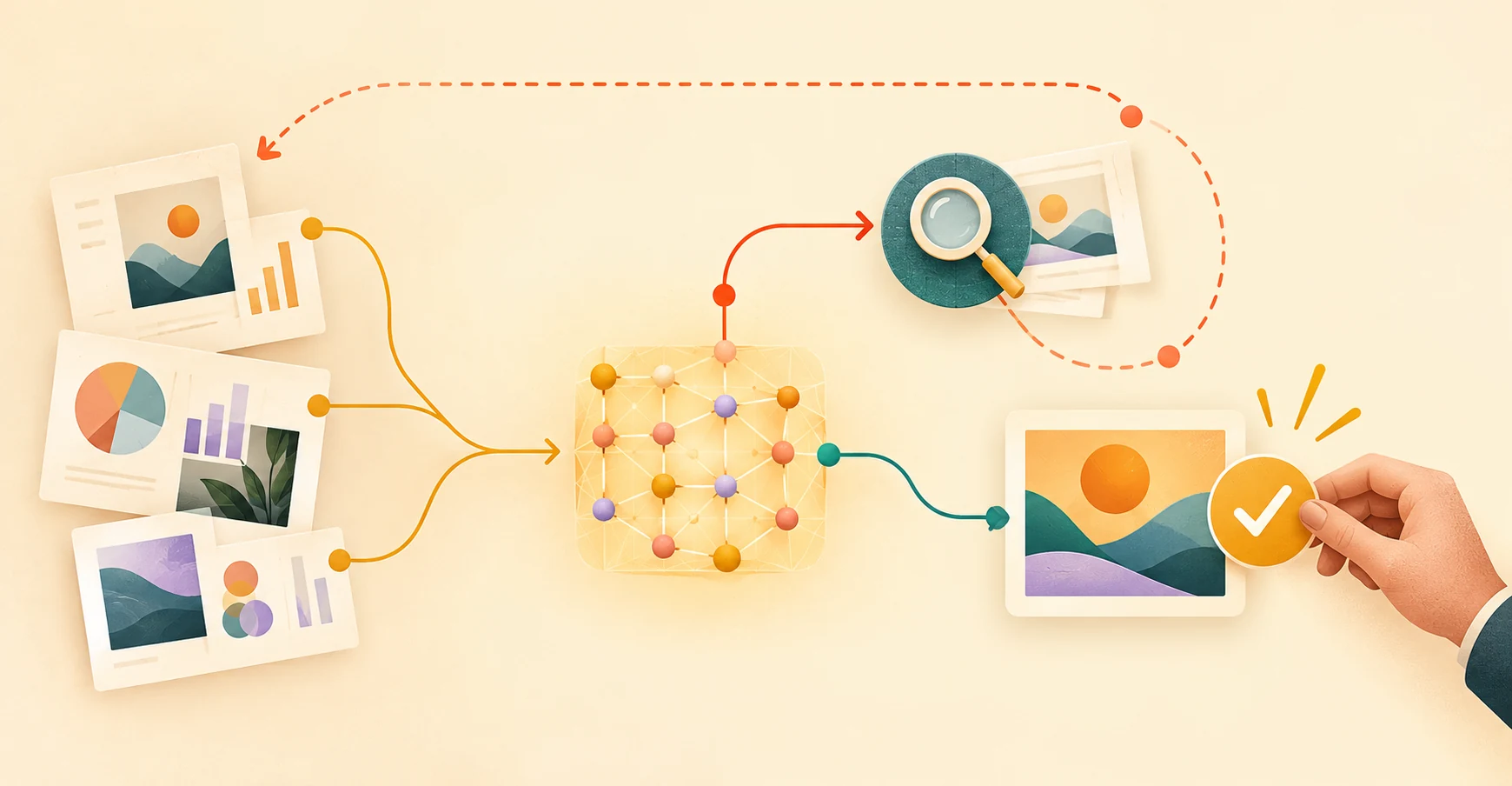
Check the total workflow.
- 01
Source
Start with traceable inputs.
- 02
Draft
Use the tool for a defined task.
- 03
Verify
Check claims, fit and corrections.
- 04
Decide
A named person approves.
If a claim cannot be traced, return to the source.
A faster first draft can still create additional work if the team has to correct claims, reconcile inconsistent versions or rebuild an unusable format. Evaluate the full path from input to approved output.
A practical review can ask: Was the input accurate? Can the source be traced? Does the output fit the brand and task? How much correction was required? What changed in the final decision?
Keep accountability clear.
The marketer remains responsible for the published claim, the interpretation and the choice. Tools can extend the work, but ownership still needs a name. That includes deciding when the evidence is insufficient and when a task should be handled directly.
Useful automation gives the team more room for judgment. Its place in the workflow should be earned by the quality of that result.